What is geoblocking? Why it happens and how it works


You might open a website and find certain products missing, be redirected to a local version of a store, see region-specific pricing, or get a message saying a service isn't available where you are. These are common signs of location-based restrictions.
Geoblocking affects online stores, apps, subscriptions, and account-based services. It can even be driven by licensing agreements, legal requirements, fraud prevention, or business decisions about where to operate.
Please note: The information in this article is for general educational purposes only and does not constitute legal advice.
What is geoblocking?
Geoblocking is the practice of limiting, changing, or restricting access to online content, products, or services based on your location. A website detects where you're connecting from and allows some actions, limits others, or blocks access entirely.
This differs from geotargeting, which personalizes content based on location. Geotargeting may show local currency, language, or promotions. In general, it changes how content is presented, while geoblocking affects whether content, products, or services are available at all.
The restriction doesn't always look like an outright block. Some services show different catalogs by region. Others disable features or prevent purchases from certain countries. In each case, location affects what you can do, not just what you see.
Common examples of geoblocking
Geoblocking can look different depending on the service, but a few patterns are common: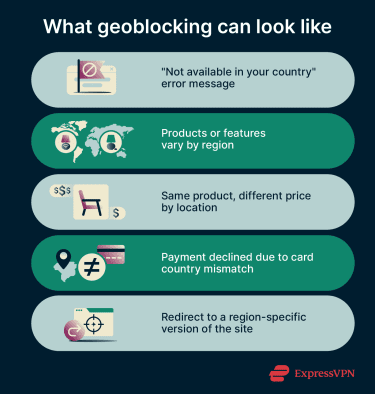
- Access denied: A website or store returns an error page or "not available in your country" message when it detects your location.
- Different content libraries: A streaming or media service offers different shows, movies, or content depending on the region.
- Region-specific pricing: The same product or subscription may cost more or less depending on your location, currency, taxes, local market, or available offers.
- Payment declined: A transaction is flagged or rejected because the payment card, billing address, account region, IP address, or device location doesn't match the service's expected country or fraud checks.
- Redirected to a different version: A user visiting one version of a site is automatically redirected to a region-specific version, which may offer different options or pricing.
Some of these happen before you interact with the site. Others only appear at checkout, login, or account creation.
How does geoblocking work?
Geoblocking usually works in two stages: first, a service estimates your location, then it applies rules to decide what you can access. These rules determine whether content is allowed, restricted, or blocked entirely.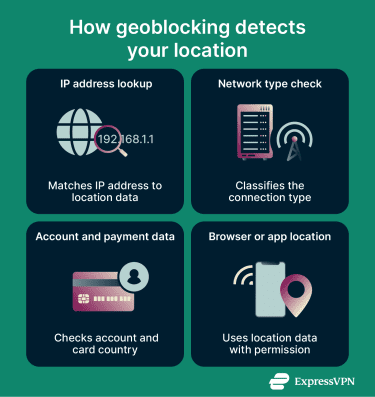
How websites and apps estimate your location
IP address lookups
The most common method is the IP address, a numerical label assigned to your internet connection by your internet service provider (ISP) or network provider. When you visit a website, your IP address is included in the request, allowing the site to see it.
On its own, an IP address doesn't contain precise location data, but it can be linked to the network that owns or announces it. This may include an autonomous system number (ASN), which indicates whether the connection originates from a home provider, a mobile carrier, or a data center.
To estimate location, services use geolocation databases from providers such as MaxMind or IP2Location. These map IP address ranges to approximate locations. Country-level accuracy is generally much higher than city-level accuracy, which can vary widely. Mappings can also become outdated as IP ranges are reassigned.
Mobile networks and shared IPs
Mobile carriers and some fixed broadband ISPs often route many users through shared public IP addresses using Carrier-Grade NAT (CGNAT). Instead of each subscriber having a separate public IP, multiple connections appear to come from a single shared address.
This conserves the limited supply of available IPv4 addresses. But it can create a problem for geolocation. The database entry for a shared IP may point to the carrier's network gateway rather than an individual user's location. This can place someone in the wrong city or region.
Because many users share the same public IP address, activity from one person can affect others. This can trigger fraud checks or cause a site to temporarily block or limit requests from that address.
Network type and IP reputation
Some services use network type as an additional signal. Connections from data centers or hosting networks may be flagged because this infrastructure is commonly used by virtual private networks (VPNs), proxy services, and automated systems.
Services may also consider IP reputation, which indicates whether an address has been associated with abuse, automation, or unusual traffic patterns. A decision is typically based on a combination of these signals.
Other location signals
Websites and apps can also use signals beyond the IP address:
- Browser geolocation: Browsers can share precise location data using available device signals, such as GPS or Wi-Fi positioning, but only with the user's permission.
- Mobile app location access: Mobile apps (not typically websites) can request access to GPS, Wi-Fi positioning, and cell tower data. This requires user permission and can provide much more accurate estimates than an IP lookup.
- Domain Name Server (DNS) resolver location: DNS can sometimes provide location hints, especially to DNS providers, content delivery networks (CDN), or authoritative DNS servers involved in routing traffic. However, a normal website request doesn't usually reveal the user's DNS resolver to the destination website. Encrypted DNS protects DNS queries from some network observers, but it doesn't necessarily prevent DNS infrastructure from using resolver location or approximate client-network signals.
Also read: Location services explained: How they work and how to protect your privacy.
How access is allowed or blocked
Once a service estimates your location, it compares that result against a set of predefined access rules. These rules determine what actions are permitted in that region.
Allowlist
Only users from approved regions can access the content, product, or service. This is common for licensing-restricted platforms, such as streaming services. If your location isn't on the list, access is denied by default.
Blocklist
Specific regions are restricted, while others are allowed. This approach is often used for legal or regulatory compliance, sanction-risk controls, or fraud prevention. If your location matches a blocked region, access is denied.
In practice, services often combine both approaches with additional checks. For example, a platform may allow access from a region but still restrict actions if account details, payment origin, or IP reputation appear inconsistent.
Depending on the outcome, the service may allow full access, show a limited version of the content, require additional verification, or block access entirely.
Account and payment checks
IP detection is one layer. Many platforms also check account and payment information to enforce regional restrictions.
Account region locking
This is common on platforms that tie purchases or subscriptions to a country. App stores are a clear example. Both Apple's App Store and Google Play link accounts to a registered country or region.
That country can affect which apps are available, what prices appear, and which payment methods work. Changing it often requires meeting platform-specific conditions, such as being in the new country, adding a local payment method, spending or leaving behind remaining store credit, or canceling subscriptions that block the change.
IIN/BIN checks
The Issuer Identification Number (IIN), often still called a Bank Identification Number (BIN), is now an eight-digit identifier under the International Organization for Standardization (ISO) / International Electrotechnical Commission (IEC) 7812. It identifies the card-issuing institution and is commonly used to infer the card's issuing country.
If someone tries to make a purchase from one country using a card issued in another, some platforms may treat this as a risk signal. Many services compare IP location, account country, and payment origin. If these signals conflict, they may request verification, restrict access, or decline the transaction.
Also read: What can someone do with your IP address?
Why is geoblocking used?
The reasons behind geoblocking generally fall into these areas: licensing restrictions, regional pricing and availability, and legal, regulatory, or security requirements.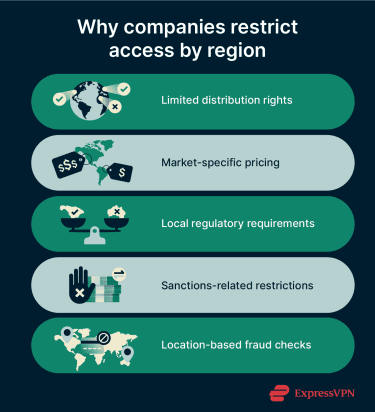
Licensing and distribution limits
Products, content, and services are often licensed on a territory-by-territory basis. A company might grant distribution rights to different partners in different regions, and each partner can only offer it within the territories covered by their agreement. For example, a streaming service may have rights to show a movie in one country but not in another.
The same product might be available in one country and absent in another simply because another company holds the rights for that region, or because the rights are not available there. Geoblocking can enforce those boundaries by restricting access based on the user's detected location.
Regional pricing and availability
Companies sometimes set different prices for different markets based on local purchasing power, taxes, competition, or currency differences. For example, a service may show different prices depending on the country selected in its store.
To prevent users from buying at a lower price intended for another region, services may limit purchases based on location, billing country, or payment method.
Availability can also vary for regulatory reasons. A product approved in one country may not meet safety or labeling standards in another. Some services require local infrastructure or legal entities that aren't established in every market.
Legal compliance and fraud prevention
Some location-based restrictions are used to meet legal or regulatory obligations. In the U.S., the Office of Foreign Assets Control (OFAC) administers sanctions involving certain countries, regions, entities, and individuals. Businesses subject to sanctions rules may need to screen customers, transactions, or access attempts against those restrictions. OFAC guidance and enforcement actions have highlighted IP address and location checks as possible parts of a sanctions compliance program.
Fraud prevention systems also use location data. A login from an unusual country or a payment card used far from its issuing location can trigger extra verification, limited access, or a blocked transaction.
What happens when your location changes
A service that works normally at home may be restricted when you travel. The platform may detect your current IP address and treat you as a user in that new location. Whether full access continues depends on the platform and how its licensing, account, payment, or regional rules are structured.
Some services continue normal access for existing accounts. Others restrict access based on your current detected location, regardless of where your account was created. Some platforms check location at sign-in, while others may check it again during checkout, streaming, account creation, or ongoing use.
Users who relocate permanently can face a different issue. If login locations, payment details, or store settings no longer align with the account's registered country, some platforms may limit access or require users to update their region settings.
Related: How to fix "your IP has been temporarily blocked."
Is geoblocking legal?
Geoblocking may be lawful in many cases, but the rules vary by jurisdiction, service type, and the reason for the restriction. In many places, businesses can choose where they offer products or services, provided they comply with applicable consumer protection, trade, and sanctions laws. Some regions, however, limit when and how location-based restrictions can be applied.
The European Union is one example. The EU Geo-blocking Regulation (Regulation (EU) 2018/302), which has applied since December 2018, restricts certain forms of location-based discrimination when customers in the EU interact with traders operating in the EU. It limits certain blocking or redirecting based on nationality, residence, or place of establishment. It also limits the application of different terms of access or sale in covered situations where the difference isn't objectively justified.
The regulation doesn't apply to all services. Some categories are excluded, including audiovisual services, transport, financial services, and certain electronically supplied services whose main feature is access to copyright-protected works, such as e-books, music, online games, or software.
However, under separate EU portability rules, providers of paid online content services must allow subscribers to access the same content when they are temporarily in another EU country. This means a user traveling within the EU should generally still be able to use their home subscription, even if that content is normally restricted in the country they are visiting. These rules apply within the EU and do not extend to travel between the EU and the U.K. following Brexit.
The regulation also doesn't require businesses to offer identical prices across EU countries.
There's also a difference between legal requirements and platform rules. Accessing a service from another region may not violate any law, depending on the circumstances. But it could still breach the platform's terms of service if those terms restrict use to specific locations.
Can trying to get around geoblocks break platform rules?
Many platforms restrict access by region in their terms of service. Attempting to access a service from a location that doesn't match a user's account or expected region may violate those terms.
Platforms may check whether a connection comes from infrastructure commonly used to mask a user's real location. This can include VPN services, proxy servers that relay traffic through another network, or The Onion Router (Tor), a privacy network that routes traffic through multiple relays. They may also flag mismatches between signals, like an account registered in one country suddenly logging in from another, or a payment method that doesn't match the expected region.
Some platforms also look at behavior, such as frequent location changes or rapid IP address switching.
If a platform detects something inconsistent, it may respond by requiring a CAPTCHA or identity verification, restricting features, limiting access, or, in some cases, suspending the account. The response depends on the platform and how it interprets the activity.
FAQ
Why do some websites show different prices based on location?
Does geoblocking only happen when I travel?
What information can a website use to estimate my location?
With permission, browsers and mobile apps can provide more precise data using GPS, Wi-Fi positioning, or cell tower signals. The signals a service uses depend on the platform and the permissions the user grants.