Is Ahmia safe to use? What you need to know before you search



Ahmia is generally considered a legitimate search engine for browsing the dark web. It indexes publicly available sites and filters out illegal or malicious content where possible.
Many users turn to Ahmia as part of a broader toolkit for online privacy and anonymity, often alongside the Tor browser and virtual private networks (VPNs). However, using Ahmia doesn’t guarantee safety or anonymity on the dark web, and the Tor network itself carries inherent risks.
This article explains whether Ahmia is legitimate and explores its privacy features. It also looks at the risks of using Ahmia, how to access Ahmia safely, and what the alternatives are.
What is Ahmia?
Ahmia is a search engine designed for the Tor browser, which lets users access the dark web and explore web services on the Tor network. Many of these services use .onion addresses, which are special domain names that can only be reached through Tor and are designed to keep both users and sites anonymous.
Ahmia was created by Juha Nurmi, a developer and academic researcher who focuses on online safety and the Tor ecosystem. His work has explored how people use anonymous networks, including research into harmful content and how it spreads.
Ahmia indexes publicly available .onion sites, but it applies filtering to exclude content that’s known to be unsafe or unlawful. However, Ahmia can’t guarantee that all harmful or malicious sites are excluded. As with any dark web tool, users should still exercise caution and follow safe browsing practices when accessing results.
What is Ahmia used for?
Ahmia helps users find and access publicly available .onion sites on the Tor network, as traditional search engines like Google or Bing don’t index most Tor sites. Journalists and researchers can also use Ahmia to locate whistleblowing platforms or other sources that discuss sensitive topics.
In some regions, Ahmia may help users locate websites that are otherwise difficult to access due to local internet censorship. The Tor network’s design aims to reduce the exposure of a user’s identity, which can help protect privacy in these kinds of environments.
Security professionals and researchers may use Ahmia to explore the Tor network and look for signs of emerging cyber threats, leaked data, or discussions on underground forums.
Not all use cases are legitimate or legal. Some bad actors may also use tools like Ahmia to locate marketplaces or forums associated with illegal activities.
How does Ahmia work?
Accessing Ahmia requires the Tor Browser, since .onion websites, also known as hidden services, are not reachable through standard browsers. Ahmia can be visited either through its .onion address or via its clearnet site, ahmia.fi. It is also worth noting that Ahmia may not always appear in results from Tor Browser’s default search engines.
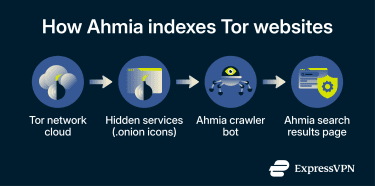
Here’s how Ahmia works, in a nutshell:
- Crawls the dark web: Ahmia uses specialized bots to navigate the Tor network, looking for hidden services from active hidden directories or by following links within other hidden services.
- Parses and indexes content: Ahmia’s crawlers extract relevant data from hidden services through intelligent parsing, storing it (alongside the “.onion” address) in a searchable database of titles, descriptions, and keywords.
- Uses robots.txt: Just like regular search engines, Ahmia respects the “robots.txt” file that some hidden services use to avoid being indexed. Services may choose this to remain private.
- Search functionality: Ahmia uses crawled onion-site data to provide keyword-based search over indexed content. Note, however, that it doesn’t use the same advanced “user intent” ranking as mainstream search engines like Google.
- Content filtering: Ahmia actively filters certain harmful content and maintains a blocklist, but it does not guarantee that all unsafe or illegal results are excluded.
Ahmia security and privacy features
As a privacy-focused search engine, Ahmia offers several features that support safer navigation of Tor websites:
- Privacy-focused search handling: Ahmia’s privacy policy says it does not log IP addresses or store personal data. This may reduce privacy risks compared with clearnet search engines, though total anonymity is not guaranteed.
- Public transparency updates: The project publishes reports covering topics such as indexed services, filtering practices, and development updates.
- Open-source community involvement: Because Ahmia is open source, developers and privacy researchers can review the code and contribute improvements or feedback.
- Filtering for illegal content: Ahmia attempts to filter illegal or harmful content from indexed results. While not perfect, this adds a degree of protection for users navigating the dark web.
Risks of using Ahmia
While Ahmia itself is a legitimate search engine, the Tor network contains a large quantity of harmful content that Ahmia may not be able to block entirely. This can include misleading links that can lead to illicit and malicious websites.
Since the dark web is largely unrestricted and ungoverned, it’s commonly used for illegal activities. Websites created to this end are live on the Tor network, and anyone can access them, including unsuspecting Ahmia users (though Ahmia works to reduce this risk).
Privacy and tracking concerns
According to its Privacy Policy and Terms of Service, Ahmia doesn’t store your IP address, use cookies, create user profiles, or store any identifiable user data. However, it may collect limited non-personal logs, including search terms, clicked result links, browser user-agent data, referrer headers, and request timestamps.
Internet privacy risks could also arise when users access Ahmia through its clearnet version or when they open links to external .onion services. These websites operate independently and may attempt to track visitors, collect data, or host malicious content.
Legal and ethical issues
Using Ahmia itself is legal in most regions, as it functions as a search engine for publicly available Tor websites. However, some of the search results you come across may lead to services or platforms connected to illegal activities.
How to use Ahmia safely
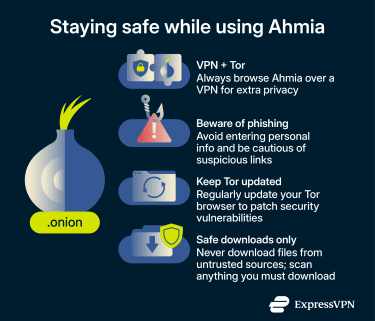
Users interested in the Tor network who want to access Ahmia safely should follow several secure browsing practices:
- Always use a VPN: A solution like ExpressVPN masks your real IP address and encrypts your traffic before it enters the Tor network. This helps prevent your internet service provider (ISP) or local network from seeing that you’re using Tor and adds an extra layer of privacy.
- Watch for phishing scams: Don’t ever enter personal information on websites found on the Tor network, and be careful about clicking phishing links. Suspicious sites may attempt to steal your credentials or payment information or install malware.
- Keep the Tor browser up to date: To avoid Tor network security vulnerabilities, always update the Tor browser as soon as new patches are available.
- Practice healthy download habits: Never download files or apps from untrusted sources on the dark web, as they may contain malware like worms or keyloggers. If you must download something (and we strongly advise against it), make sure to scan it with an antivirus first, and avoid installing software that requests elevated permissions.
Red flags to watch for
Recognizing the common warning signs can help to avoid dark web scams and reduce the risk of visiting malicious websites. Here are some key red flags:
- Lookalike .onion addresses: .onion URLs are long and random, which makes them significantly more difficult to verify at a glance. Attackers may sometimes alter the address of legitimate .onion sites to imitate them. If a link looks unfamiliar or differs slightly from a known .onion address, be cautious.
- Broken or frequently changing links: Many .onion services are unstable, which means that search results can lead to broken or inactive pages and constant redirects. Frequently changing addresses may also indicate compromised websites.
- Suspicious offers or marketplaces: The Tor network has many forums and marketplaces, some of which are at best untrustworthy and at worst downright illegal. Sites offering unrealistic deals, unusually cheap products, or “exclusive” services could be scams or links to illegal marketplaces.
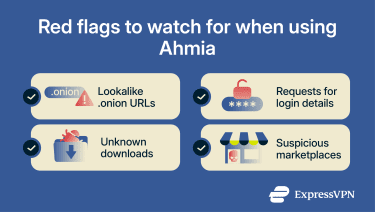
Many of these red flags are also common to regular internet browsing, but .onion services introduce additional, unique risks. The anonymity of both operators and users makes scams harder to detect and mitigate, so it’s vital to treat unknown .onion addresses with extra caution and verify sites through trusted sources.
Alternatives to Ahmia
Ahmia isn’t the only search engine that lets users access the dark web. Alternatives include:
- DuckDuckGo (DDG): Useful for private searches while using the Tor browser (it’s the default Tor search engine). Unlike Ahmia, which focuses mainly on indexing .onion sites, DuckDuckGo also searches clear websites and offers general information results.
- Torch: A very old search engine for the dark web, Torch has one of the largest indexes of .onion sites but uses minimal-to-no result filtering. It’s best used for wide searches or advanced dark web threat analyses. Researchers may also use it for open-source intelligence (OSINT) due to the large index.
- Onion Search Engine: A Tor search engine designed for large-scale discovery and analysis of .onion content. Onion Search Engine can help researchers and security teams automate dark web monitoring, and some versions can also offer access to .onion sites via APIs.
FAQ: Common questions about Ahmia
Can I accidentally visit illegal sites through Ahmia?
How much of my activity does Ahmia track?
Why don’t some .onion sites appear in Ahmia search results?
Another reason is that not every .onion service is automatically discoverable. Ahmia relies on crawling and operator submissions to build its index, so some sites may be missing simply because they have not been found yet or have not been submitted for indexing.
Some sites may also be excluded intentionally. Ahmia filters harmful material from its results and removes blocked sites from its index. In addition, it may delist links in response to complaints or legal requests.
Overall, Ahmia provides a curated view of publicly visible onion content, not a full map of the dark web. That is why the absence of a .onion site from Ahmia does not necessarily mean the site is offline or no longer exists.
Can I use Ahmia on a regular browser without Tor?
Should I use Ahmia or another Tor search engine?
Is Ahmia legal?
Is Ahmia the dark web?
Take the first step to protect yourself online. Try ExpressVPN risk-free.
Get ExpressVPN